


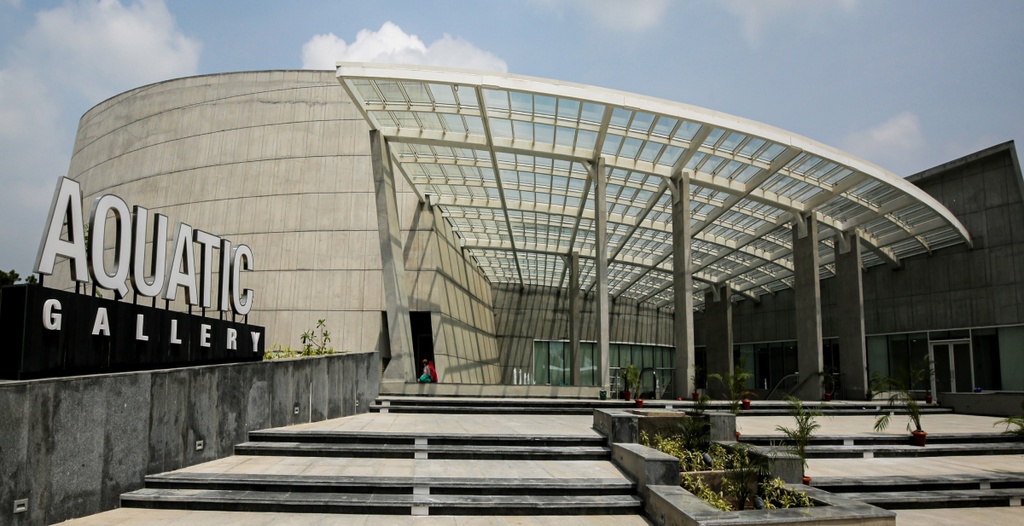
There are moments in life that stop you cold. Not in a bad way — in the way where your brain simply refuses to process what your eyes are telling it. For me, that moment happened inside a building shaped like a giant seashell, in the middle of landlocked Ahmedabad, when I found myself standing inside a 28-metre transparent water tunnel with sharks gliding silently overhead
Here are the complete details of Aquatic Zone which includes location, timings and charges.
Location:
Aquatic Zone is one of 8 activity gallery/zone located in the science city ahmedabad
Address: Bhadaj Circle, Science City Road, Sola, Ahmedabad, Gujarat
Charges:
| Sr. No. | Entertainment | General (Above 3 yearsof age) INR | School Group (Minimum group of 10 or above) INR * Per Person |
|---|---|---|---|
| 1 | Entry | 200 | 50 |
| 2 | 5D theatre | 150 | 150 |
There are combo packages too where you can see other galleries and zones , ticket combo you can see here
Timing:
10 am to 7 Pm (Science City remain closed on Monday)
The Tunnel — Where It All Begins (and Breaks Your Brain)
I’ll start where my sense of reality first came apart: the shark tunnel.
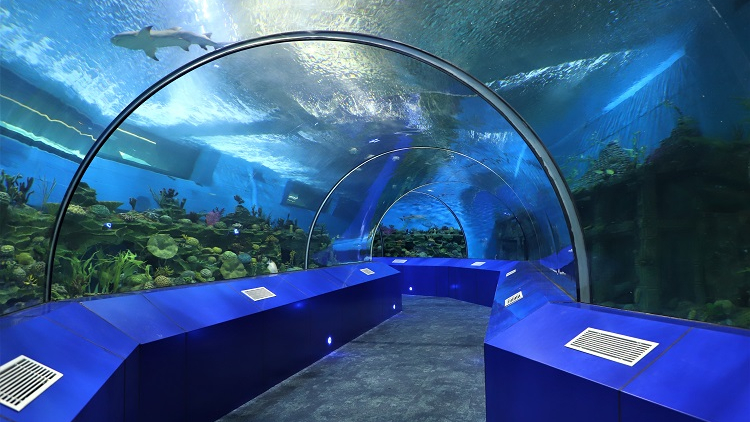
Deep inside the Ocean Zone sits the main tank, and running right through it is a 28-metre walkway enclosed entirely in acrylic glass. You step in, and the water closes around you on three sides — to the left, to the right, overhead, and if you look down, even beneath your feet. The ocean is everywhere. And moving through it, with the slow, unhurried authority of creatures that have ruled their world for hundreds of millions of years, are sharks.
Three primary species patrol this tank. The first is the Sandbar Shark (Carcharhinus plumbeus), a powerful, broad-bodied shark native to the Atlantic Ocean and the Indo-Pacific. It typically grows up to 180 cm and feeds on small bony fish, rays, crabs, and crustaceans. There is nothing casual about watching one pass three feet above your head. The second is the Grey Reef Shark (Carcharhinus amblyrhynchos), also called the Blacktail Reef Shark, found across the central Pacific and the eastern Indian Ocean. It can grow up to 255 cm and weigh up to 33.7 kg, and it is an active, true carnivore — feeding on bony fish, squid, octopus, and crustaceans. What stunned me most when I read about it later is that the Grey Reef Shark can detect the scent of tuna fish diluted to one ten-billionth of the surrounding water. It was smelling things in that tank I cannot begin to imagine. The third species is the Zebra Shark (Stegostoma fasciatum), perhaps the most visually striking of the three — patterned in a way that makes it look like the ocean commissioned its own textile design. Found in the shallow inshore waters of the Western Pacific and Indian Ocean, the Zebra Shark can grow up to an astonishing 354 cm and 120 kg, and its long tail — which can grow two to three times the length of its body — makes it extraordinarily agile. It belongs to the carpet shark family, and up close, through the tunnel glass, it is one of the most beautiful things I have ever seen. In 2023, a Lemon Shark was also introduced to the tank, adding yet another resident to this already breathtaking underwater neighbourhood.
Sharing the water with the sharks are Spotted Eagle Rays (Aetobatus narinari) — found across the Atlantic, Pacific, and Indian Oceans — which glide through the tank like living kites, their wing-like bodies undulating in slow, hypnotic waves. Their whip-like tails can grow two to three times the length of their disc-shaped bodies. Watching them soar overhead while sharks cut silently through the blue behind them is the kind of sight that makes you forget to breathe.

